
Key takeaways



Since January, the U.S. administration has put forth a series of executive actions—ranging from executive orders to tariff announcements—that clearly signal a new direction in domestic energy policy. This new approach favors growth in fossil fuels and electricity while scaling back the support that renewable energy had under the prior administration. Uncertainties remain in the specific implementation of these new policies, so we approach these actions in the same way that energy business leaders should: by considering the general direction set by the administration as well as the market and policy forces that will shape the final outcomes.

While fossil fuels are now back in play and wind and solar may be pushed to the sidelines, the administration’s goals of ensuring affordable, abundant energy will still require an ‘all-of-the-above’ energy approach.
David Carter, Industrials Senior Analyst, RSM US LLP
Key executive actions
Among a flurry of executive orders and actions, many are noteworthy for the energy ecosystem, including the following:
- “Unleashing American Energy” (EO 14154) covers a variety of topics supporting increased U.S. production of fossil fuels, biofuels, critical minerals and electricity. It also ends the pause on approvals for new liquefied natural gas (LNG) terminals and begins removing the vehicle emissions standards that favored adoption of electric vehicles.
- “Declaring a National Energy Emergency” (EO 14156) invokes various emergency powers to expedite approvals for energy production, transportation, refining and generation, including for fossil fuels, biofuels, refined petroleum fuels, nuclear power and critical minerals.
- The memorandum known as the Offshore Wind Memo blocks any new offshore wind projects and subjects existing onshore and offshore wind leases on federal land to review and possible lease termination.
- “Unleashing Alaska's Extraordinary Resource Potential” (EO 14153) lifts restrictions for the production of oil, natural gas and minerals in Alaska (including in the Arctic National Wildlife Refuge) and opens the door for new LNG export facilities in Alaska.
- “Strengthening the Reliability and Security of the United States Electric Grid” (EO 14262) supports expedited permitting and slowing the decommissioning of generation plants to serve the growing need for power generation.
Impacts
Fossil fuels are back in favor with the new administration, and the direction of its executive orders will hopefully work to resolve many of the infrastructure and permitting constraints impacting the energy sector. However, it’s important to recognize that market forces drive investment in new projects, whether for additional oil and gas production or LNG terminals.
Here’s a look at how the landscape has changed so far this year for various energy subsectors:
Oil
Global markets have seen West Texas Intermediate oil prices fall by more than 25% from this year’s high in January of $80 per barrel to near $60 per barrel due to concerns of a global economic slowdown dampening demand. Meanwhile, OPEC+ has resumed production at higher-than-anticipated levels despite forecasted surpluses in 2025 and 2026. The lower price is good for consumers, but sustained oil prices near $60 per barrel are likely to keep production flat this year, and sustained prices near or below $55 will drive U.S. production cuts.
Natural gas
Demand growth remains strong, driven by increasing power demand, industrial demand and the need for more winter heating. Improved pipeline infrastructure to transport gas from high-production areas will improve gas production and project economics going forward.
LNG
Export capacity is poised to rapidly expand in the coming years from projects already under construction, from 15.5 Bcf/d (billion cubic feet per day) at the end of 2024 to 25.1 Bcf/d by the end of 2027, an increase of 62%. Between 22 Bcf/d of existing approved new capacity (unaffected by last year’s Department of Energy pause) and the current administration’s approval of additional capacity, the total authorized exports to date amount to over 49 Bcf/d, more than tripling current U.S. capacity.
Electricity
The U.S. is seeing a surge in electricity demand growth—2%−3% annual growth nationally, with hot spots of 8% growth or more, compared to flat growth over the last 15 years. This growth is driven by increasing demand from data centers, industrial facilities, transportation and other electrification needs.
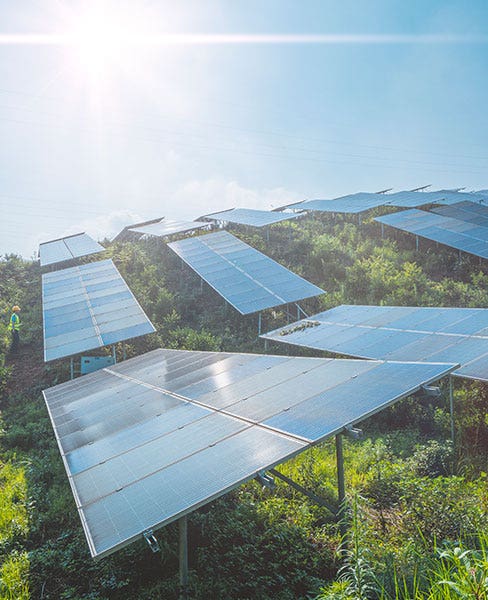
While nearly all power sources except wind and solar are preferred under administration policies, all (including wind and solar) will benefit from streamlining of permitting and other administrative processes that slow the approval of new electricity infrastructure. Wind is likely to see limited growth in the coming years, but solar will continue to see significant growth (despite being out of favor) due to its ability to be constructed within 12 to 18 months—faster than any other power source.
Risks to the outlook
While the executive actions have clearly signaled the administration’s direction, significant uncertainties remain, including:
- Which executive actions will be challenged in court and subject to interpretation once implemented in law
- The impact of tariffs on energy companies’ operating costs and overall demand
- Whether parts of the Inflation Reduction Act might be pared back or removed, and the potential impact on energy companies
- How the shifts in the administration’s energy policy will interplay with global economics, as well as with international regulations such as the EU’s carbon border adjustment mechanism
Takeaways
While fossil fuels are now back in play and wind and solar may be pushed to the sidelines, the administration’s goals of ensuring affordable, abundant energy will still require an “all-of-the-above” energy approach:
- The role of natural gas as a top energy source in North America and globally, and the United States’ role as a global leader in natural gas production and exports, are further cemented with the new policy stance.
- Policy shifts will have less impact on oil and gas output and LNG capacity in the near term than expected commodity prices and economic conditions. However, the more favorable policies across the fossil fuel landscape, along with the promise of investments in energy infrastructure (especially gas pipelines and electric transmission lines), are likely to support further investment in the long term.
- New policies present strong headwinds in the U.S. for offshore wind, and for onshore wind to a lesser extent. While solar power is out of favor, it lacks the same strong policy opposition as wind and—especially when paired with battery storage—has strong growth expectations ahead.
As businesses position themselves for the coming years, leadership teams will be well served to distinguish between the rhetoric and reality of how the administration accomplishes its stated goals.
Related insights
- /insights/industries/energy/infrastructure-constraints-limit-energy-scalability-but-present-
- /insights/industries/energy/energy-sector-companies-navigate-surge-in-electricity-demand
- /insights/industries/energy/2025-cybersecurity-mmbi-energy-snapshot