

Key takeaways



In mergers and acquisitions transactions, taxes are often a significant value driver. A well-advised seller can get on the right side of the value ledger through proactive planning, thoughtful negotiation and disciplined execution. Achieving those outcomes often requires multiple advisors with distinct roles and perspectives, each contributing to how tax opportunities are identified, risks are managed and value is ultimately preserved.
Maximizing value around taxes in a transaction can include:
- Minimizing seller taxes on sale through proper planning and structuring
- Identifying target company tax attributes and marketing to buyers (such as net operating loss carryforwards, asset step-ups, credits and incentives)
- Anticipating and getting ahead of potential areas of tax risk that could cause deal friction and value erosion once buyers conduct tax diligence
Addressing these complexities successfully can be a wide-ranging undertaking, one that often requires a team of professionals each providing key insights. In the following, we examine the roles of various advisors in a sell-side, tax-related context, and how sellers can utilize advisor expertise to produce winning outcomes.
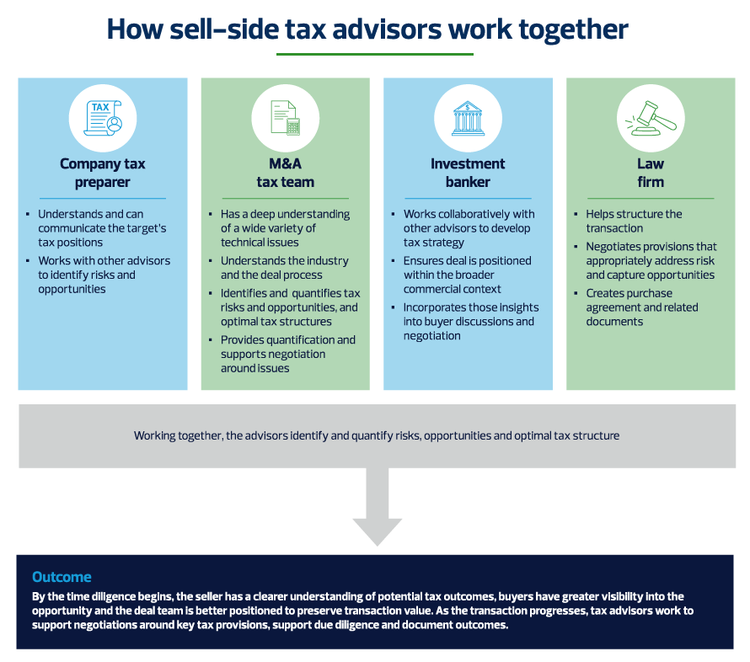
Investment banker: Bringing tax value into the deal narrative
An investment banker is tasked with making a market for the target company, helping to negotiate terms and structure, and quarterbacking the sales process from inception to closing. They need to see the big picture and drive the best overall outcome for the sellers and target company.
Investment bankers will often bring concepts to the table for maximizing value around taxes. They will work with the sell-side tax advisors to understand the commercial significance of tax matters, flesh out technical positions and uncover seller-friendly outcomes.
Early and frequent communication is key. For example, by working with a target’s tax advisors, the investment banker may be able to understand and communicate the value of the target’s tax attributes prior to the target receiving final bids and entering into a letter of intent.
Law firm: Structuring and documenting tax outcomes
The target company will typically engage a law firm to serve as primary deal counsel. The target or sellers may also hire additional counsel to address specific matters or represent certain interests.
Counsel will typically play multiple roles in the transaction process, including drafting the purchase agreement and other legal documents, negotiating deal terms, maintaining and resolving issues lists, and supporting legal diligence.
Frequently, a tax attorney will be part of a seller’s legal team. An effective tax counsel will work closely with their legal colleagues and other advisors to make sure tax issues are considered and resolved commercially within the context of the transaction. They are also essential in making sure negotiated outcomes and intents are properly captured in the transaction documents. They may also be involved in the legal and tax structure of the transaction.
Accounting firm: Delivering tax insight throughout the deal lifecycle
Company tax advisor (tax return preparer)
Typically, when it comes to taxes, the target company’s accounting firm is at the heart of the matter. Team members will likely have the most historical knowledge and perspective on the company’s tax function. This will likely include income tax return and tax provision preparation, but may also include sales tax, payroll taxes and other various tax planning steps.
Leveraging this experience early and often in the deal process is key. Working with M&A tax and other specialists, accountants can help identify risks, opportunities and planning strategies for the transaction. Closer to process launch, they should help the seller and the investment banker prepare the data room. Once buy-side diligence begins, they will need to represent the company on calls with buy-side diligence providers, respond to requests, and help to advise the seller and their counsel on deal terms related to tax matters.
Post-closing, having advisors like those in this team who understand transactions is essential for proper reporting and making sure the results negotiated for are realized on tax returns.
M&A tax team
The role of an accounting firm’s M&A tax team on a sell-side transaction is critical. For target companies with smaller or less experienced primary tax advisors, engaging a dedicated M&A tax professional can fill an important gap in expertise. However, even companies with experienced primary tax advisors can benefit greatly from using a dedicated M&A tax professional.
Note that the M&A tax team and the company’s tax return preparer can, but may not necessarily, be from the same firm.
M&A tax professionals at accounting firms spend all their time on deals. They have an understanding of planning ideas, technical tax rules, market practices on tax matters and deal cadence that make them an integral part of the team. They have connections to firm specialists in relevant areas and understand how to deploy them to support the deal.
Some areas where accounting firm M&A tax professionals create unique value are as follows:
-
Sell-side due diligence: Target companies can benefit from a sell-side due diligence exercise in which a sell-side M&A tax team will perform tax diligence on the company in advance of (or early in) a sales process. By identifying issues before going to market, a company will have the ability to assess mitigation strategies and determine how best to position the issue in the deal context. The company may also have opportunities to pursue tax benefits. Understanding this can allow the company to communicate and negotiate for the value of these benefits.
-
Diligence preparedness and support: Even if not conducting a sell-side tax diligence, an M&A tax professional can provide insight and facilitate company preparedness for buy-side tax diligence. This might include helping a seller populate a data room, understanding what items and issues buyers are likely to focus on, and discussing how best to respond to inquiries.
Once buy-side diligence begins, they can be a vital sounding board, lending perspective on buyer asks, significance of asserted issues and market practices. They can also help to refute or quantify alleged tax exposures, mitigating purchase price erosion and unfavorable risk allocation.
Experience in both buy-side and sell-side tax due diligence across many deals provides M&A tax advisors with a unique perspective clients can benefit from.
-
Tax structuring: An area where the skills of tax counsel and accounting firms overlap is tax structuring. On many engagements, attorneys and accounting firms are equally capable of designing efficient tax structures and “holding the pen” on creating step plans. The right choice for who should lead structuring will depend on the client’s experience and familiarity with the respective firms, the nuances of the company and the potential transaction, and the capabilities of the firms in the relevant areas.
For example, accounting firm M&A tax professionals will have access to deep global networks and multistate capabilities, which can be leveraged onto engagements as needed. A best practice is for both tax counsel and an accounting firm M&A tax professional to be involved in tax structuring, regardless of who takes the lead. While this may seem to some sellers as paying for the same thing twice, the reality is that both sets of professionals have relevant perspectives that should be utilized. The complexity, risk and monetary significance of taxes warrants such an approach.
-
Tax modeling: Tax modeling and quantitative analysis is the domain of tax accountants. At the end of the day, sellers need to understand in dollars and cents the impacts of their decisions, whether it be expected after-tax proceeds, the value of tax attributes they could deliver to a buyer, or the relative cost of accommodating a buyer structuring request.
M&A tax professionals sit squarely at the intersection of tax law and accounting, and have insights, tools and processes to translate complexity into actionable data.
-
Accounting firms have a wealth of resources: A skilled M&A tax professional will be able to draw on these resources to support seller needs. This might mean involving technical tax resources, tax professionals in other jurisdictions across the globe or estate planning for owners about to experience a liquidity event.
Outside of the tax function, M&A tax professionals are connected to capabilities across their firms to deliver client needs on transactions. This might mean involving valuation professionals, collaborating with a financial diligence team on tax-related items affecting EBITDA in a sell-side quality of earnings or bringing in deal analytics to help the company tell their operational and financial story.
-
The most important role an M&A tax professional plays in a transaction may be that of a connector and translator between the various service providers and the client. Their technical acumen and deal experience allow them to work with attorneys and bankers to translate tax issues into negotiable items reflected in the purchase agreement. Their accounting firm lens allows them to identify and understand the significance of tax positions: past, present and future.
Often, when it comes to tax risks and opportunities in a deal, there can be a gap between the “technical” answer, what is actionable and how to implement the plan. An effective M&A tax advisor can fill that gap.
The takeaway
A collaborative approach between sellers and their advisors is vital to maximize success in a transaction, especially when it concerns taxation. Securing the best outcome means planning, negotiation, execution and follow-through. Collaboration brings context to the technical and crystalizes expertise into value.
Related insights
- /insights/services/merger-acquisition/tax-diligence-shapes-deal-value-m-and-a
- /insights/services/business-tax/tax-due-diligence-carve-out-transactions
- /insights/services/business-tax/key-sell-side-m-and-a-tax-considerations