
Examining the heightened scrutiny of grantor trusts
This article was originally published Sept. 20, 2024, and has been updated to reflect that Republicans will control a unified government beginning in 2025.
Executive summary: Scrutiny of irrevocable grantor trusts
Irrevocable grantor trusts are an effective estate planning tool partly because they offer a unique combination of tax benefits. This article examines recent political scrutiny of grantor trusts and looks ahead to their future under a unified Republican government and beyond.
Irrevocable grantor trusts offer a unique combination of tax benefits that make them a valuable tool for estate planning. This is because they are treated differently for gift and estate tax purposes than they are for income tax purposes. This special treatment can result in significant tax savings. Common types of irrevocable grantor trusts include Intentionally Defective Grantor Trusts (IDGT), Spousal Lifetime Access Trusts (SLATs), Irrevocable Life Insurance Trusts (ILITs) and Grantor Retained Annuity Trusts (GRATs).
Common types of irrevocable grantor trusts include:
- Irrevocable life insurance trusts (ILITs)
How do irrevocable grantor trusts generally work?
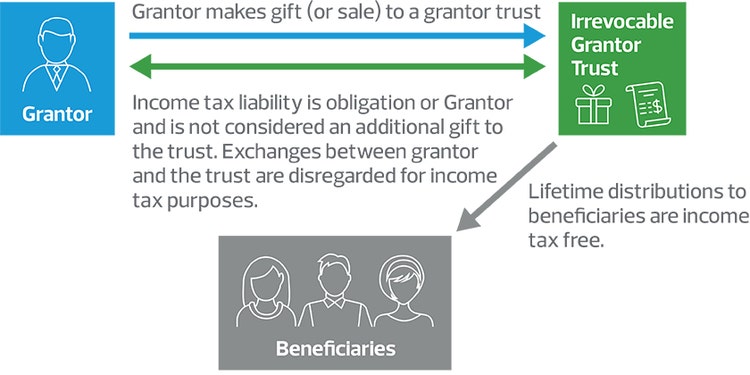
Grantor trusts are not separate entities from their deemed owner for income tax purposes. The grantor and the trust are treated as one taxpayer and the grantor is liable for the trust’s income tax. Grantor trust status can apply to the entire trust or only a portion of it, and the grantor trust status can be changed under certain circumstances.
What are some of the grantor trust tax benefits that are under scrutiny?
- Transferring assets to an irrevocable grantor trust can remove assets from the grantor’s gross estate and allow the appreciation to avoid transfer tax.
- The payment of income tax on behalf of the irrevocable grantor trust, by the grantor, is not an additional gift to the trust. This allows the trust to grow income tax free during the grantor’s life.
- Exchanges between a grantor trust and the grantor are generally not taxable transactions because the grantor is the deemed owner of the trust for income tax purposes.
- Certain grantor trust provisions allow flexibility, such as the ability to swap assets of equivalent value between the grantor and the trust without incurring income tax.
- Certain types of grantor trusts, such as a GRAT, allow individuals to transfer the appreciation on assets outside of their estate while making only a very small gift.
- trated below, these additional legislative efforts have included:
See our related articles to learn more:
How have lawmakers tried to limit or eliminate the benefits associated with grantor trusts
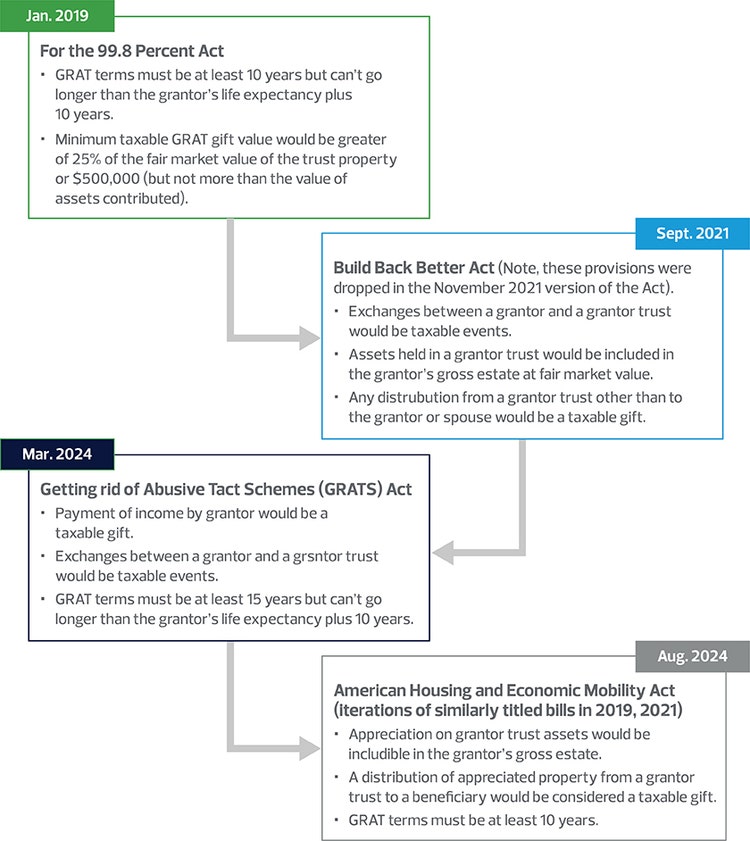
Due to the tax advantages offered by grantor trusts, some lawmakers have become increasingly concerned with their potential misuse as perceived tax avoidance tools. Repeated legislative attempts to curtail these benefits demonstrate some lawmakers’ persistence in addressing this issue, raising the question of whether these estate planning strategies may eventually become less effective or eliminated.
Both the Obama and Biden administrations proposed eliminating those perceived loopholes. The proposed measures introduced in Congress sought to limit those benefits by increasing income and/or transfer tax liabilities of high net worth individuals who utilize these techniques. As illustrated below, these additional legislative efforts have included:
What does the future use of grantor trusts look like?
With Donald Trump elected to a second term as president, as well as a Republican-controlled Congress beginning in January 2025, it is likely there will be no immediate change to the use of grantor trusts. However, there is a chance that future laws could still affect your current planning. Consult with your tax advisor to determine how these potential changes impact your estate plan.
Related insights
- /insights/tax-alerts/2024/grantor-retained-annuity-trusts-explained
- /insights/services/business-tax/estate-planning-q-and-a-spousal-lifetime-access-trusts-explained
- /insights/services/business-tax/estate-planning-q-and-a-gifting-to-idgt-explained
- /insights/services/business-tax/sales-to-intentionally-defective-grantor-trusts-explained