
Fraud considerations in the Paycheck Protection Program
The federal government has allocated hundreds of billions of dollars over the past six months via the Coronavirus Aid, Relief, and Economic Security (CARES) Act’s Paycheck Protection Program (PPP) to bring financial relief to small businesses affected by the COVID-19 pandemic. Qualifying companies that met the Small Business Administration’s (SBA) requirements were eligible to apply for immediate funding to cover payroll costs, rent and utilities as well as interest on mortgages, with the understanding that the loan would be forgiven as long as the funds were utilized in accordance with the prescribed standards. Millions of small businesses across the country took advantage of the program, with the SBA approving the issuance of 5.2 million loans totaling $525 billion through August 2020.1
“Almost every crisis brings out not only those who seek to help others, but also exploit those who try to exploit the situation for their own unlawful purposes and financial gain.” – Acting Assistant Attorney General Brian Rabbitt, Sept. 10
However, the program’s prioritization of businesses’ immediate need for loan funding came at the cost of maintaining a sufficient level of diligence, oversight and monitoring. Consequently, reports of PPP fraud have populated the news cycle in recent months, with violations by bad actors ranging from the creation of fake companies applying for funding to the egregious spending of PPP-issued funds on a new Lamborghini. In a report issued by the Select Subcommittee on the Coronavirus Crisis on Sept. 1, members of the House of Representatives estimate that tens of thousands of loans totaling billions of dollars contain indicators of, at best, violations of PPP protocol, and at worst, outright fraud.2
Before delving into the different types of fraud potentially occurring through the PPP, it’s worth exploring basic fraud theory to illustrate the elements of PPP that may allow for fraudulent conduct.
The PPP Fraud Triangle
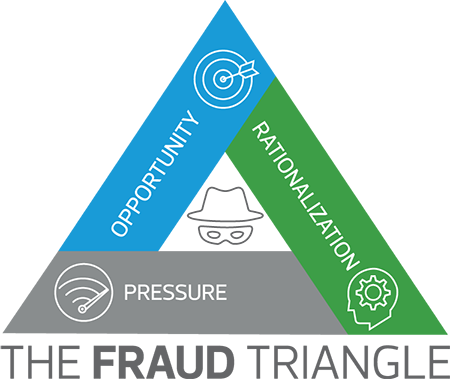
- Opportunity: In order to expedite the funding process, Congress allowed lenders to bypass more practiced levels of diligence typically performed in the course of loan evaluation and funding. Furthermore, when discussing the government’s position on investigating and reviewing the use of PPP funds on a loan-by-loan basis, Treasury Secretary Steven Mnuchin indicated that only those companies that received more than $2 million would be subject to an official audit program, and that borrowers receiving less than $2 million “will be deemed to have made the required certification concerning the necessity of the loan request in good faith.”3 While the Treasury did ultimately retract that statement, the threat of an audit or signing a “good faith certification” has not proven to be a sufficient control in dissuading those desperate for cash from creating fake companies or milking the numbers.
- Pressure: When the pandemic hit the United States in March, mandatory lockdowns and quarantine orders disrupted the revenue streams of businesses across almost all industries—while also thrusting over one-seventh of the country into unemployment. The financial pressure for businesses or individual loan applicants to make payroll, keep their doors open and provide for their employees has reached an alarmingly high level.
- Rationalization: With that pressure, many business owners and other PPP applicants may be able to justify taking advantage of the program. Perceiving the unprecedented nature of the landscape induced by COVID-19 as ‘once-in-a-generation’ can prompt applicants to inflate their true need for PPP funds or skirt appropriate documentation and support for their loans. Moreover, applicants may validate their fraudulent conduct by observing others similarly taking advantage of the program. Finally, many businesses may use the rationalization of “we need to stay open no matter what” to abuse the amount requests and actual spending of PPP funds.
Fraud by borrower
Although the individual fact patterns of each alleged borrower fraud uncovered to date are certainly unique, there are general themes found in fraudsters’ conduct. The SBA rules stipulate that as long as your company 1) met the eligibility requirements of being a small business (generally, having less than 500 employees) and 2) could produce evidence of being in operation on Feb. 15, 2020, you were eligible to apply for a PPP loan.
Given these broad regulations and a lack of rigorous due diligence performed for each application, the most popular scheme fraudsters have perpetuated thus far has involved the creation of fake companies and falsification of supporting tax returns, payroll records, bank statements and financial statements to convince lenders that these requirements were met.
In August, for example, an Arkansas resident and Walmart employee pleaded guilty to bank fraud charges after setting up a fake entity just days before submitting a falsified application seeking $4.4 million to cover payroll costs for 247 employees.4 Others have opted to use recently defunct companies as cover. A Texas man was charged in June for allegedly submitting $3 million in PPP frauds using his wife’s wedding planning business, claiming to have 120 employees this spring even though the business closed in 2018.5 Other common infractions seen so far include inflating employee counts at legitimate businesses and lying about criminal history on the applications.
A potentially more concerning development is the recent identification of sophisticated fraud rings in which multiple fraudsters cooperate to defraud the PPP. The owner of a Florida talent management company, along with eight other defendants, were charged in August for allegedly organizing a kickback scheme in conjunction with over 90 loan applications seeking more than $24 million. The business owner utilized his connections with NFL players and other professional athletes to recruit eligible applicants in exchange for a share of the loan proceeds.6
Violations by Lender
As aforementioned, prioritizing the speed of PPP loan funding over rigorous oversight of applicants resulted in the obfuscation of the lenders’ responsibilities when it came to the level of due diligence performed on the applicants. Specifically, the SBA made it clear that lenders “may rely on borrower representations” and would not be on the hook to “independently verify the borrower’s reported information if the borrower submits documentation supporting its request for loan forgiveness and attests that it accurately verified the payments for eligible costs."7 It appears that the PPP created a vacuum of responsibility regarding the possibility for fraudulent applications and thus lacked a plan for investigating and prosecuting those abusing the program.
However, PPP enforcement may be manifest internally or through the courts, versus through Congress. Shortly after the PPP was rolled out, Wells Fargo was accused of prioritizing larger loan amounts to maximize processing fees despite the SBA’s mandate that loans should be processed on a first-come, first-serve basis. Disgruntled investors are now pursuing litigation against Wells Fargo, claiming that the bank’s lack of controls surrounding PPP and the resulting misallocation of PPP funds has resulted in published lawsuits and regulatory probes that have driven down the stock price.[1] (note that prior to the publication of this article, the Wall Street Journal reported that Wells Fargo fired as many as 125 employees for conduct related to pandemic loan programs[2])
JPMorgan, meanwhile, announced a probe of its own in September after it found evidence of employee wrongdoing in the PPP process. Given the lack of oversight required, a strong inherent risk of collusion exists among lender employees who can turn a blind eye and assist in the circumvention of the approval requirements in exchange for kickbacks from borrowers.
What’s next?
As of September 10, 57 individuals have been charged with attempting to steal a combined $175 million of PPP funds, with an additional 500 individuals identified as potential suspects in an organized PPP fraud ring.[3] And this is just the tip of the iceberg: The majority of the cases identified to date have represented clear violations of SBA policy or blatantly falsified documentation.
With the loan forgiveness period ending on December 31, 2020, the DOJ’s attention is likely to shift from identifying fraudulent applications to scrutinizing where taxpayer dollars were improperly spent once received. If one thing is certain, it’s that there will be a steady stream of PPP violations in the news for the foreseeable future.
PPP loan fraud considerations include the following:
- Borrower eligibility: Did the applicant meet the SBA’s size standards and was he or she in operation and paying employees on February 15, 2020? Did the applicant only apply for one loan?
- Accuracy of application: Did the applicant apply for and receive the correct loan amount based on SBA guidelines, and did the supporting payroll and tax return documentation provided corroborate this amount? Were any documents manipulated to inflate the loan amount requested?
- Lender due diligence: Did the lender fulfill the SBA’s minimum requirements, including 1) obtaining the required borrower certifications; 2) confirming that the borrower paid employees by February 15, 2020; and 3) analyzing the average monthly payroll costs submitted with the application? Did the lender approve loan amounts despite known errors or falsifications
- Use of funds and loan forgiveness: Once the funds were received, did the borrower utilize at least 60% of the funds for payroll, with the remainder spent on rent, utilities and interest on mortgages? Did the borrower maintain required headcount and salary levels?
- PPP audit: Is the borrower prepared for the SBA’s Office of the Inspector General to conduct an audit into the accuracy of the amounts listed on the loan application and validity of the certifications? Have the necessary documents and schedules been prepared to proactively defend against scrutiny? Have the appropriate legal and accounting experts been consulted?
Much is still developing regarding the use, audit and potential actions to be taken under PPP. Although businesses may feel comfortable waiting to see how government scrutiny evolves around the program, it may be wise to consider preparing for the scrutiny now, while documents are at hand and while understanding is still fresh. A defensible position regarding application, use and tracking of PPP funds can only benefit a business that takes these measures going forward.
1 “Paycheck Protection Program (PPP) Report.” U.S. Small Business Administration.
2 “Preliminary Analysis of Paycheck Protection Program Data,” House of Representatives Select Subcommittee on the Coronavirus Crisis.
3 “Paycheck Protection Program Loans Frequently Asked Questions (FAQs).” United States Treasury Department.
4 “Arkansas Project Manager Pleads Guilty to Bank Fraud and False Statements in Connection With Covid-Relief Fraud.” United States Attorney’s Office, Northern District of Oklahoma.
5 “Texas Man Charged with COVID-Relief Fraud, False Statements and Money Laundering.” United States Department of Justice.
6 “Nine Charged with $24 Million COID-Relief Fraud Scheme.” The United States Department of Justice.
7 “Business Loan Program Temporary Changes; Paycheck Protection Program—SBA Loan Review Procedures and Related Borrower and Lender Responsibilities.” Federal Register.
8 “Rosen Law Firm To Lead Wells Fargo Investors’ PPP Suit.” Law360.
9 “Wells Fargo Fires Employees Who Applied for SBA Pandemic Loans.” Wall Street Journal.
10 “Acting Assistant Attorney General Brian Rabbitt Delivers Remarks at the PPP Criminal Fraud Enforcement Action Press Conference.” United States Department of Justice.