
Puerto Rico issues guidance for transfer pricing compliance
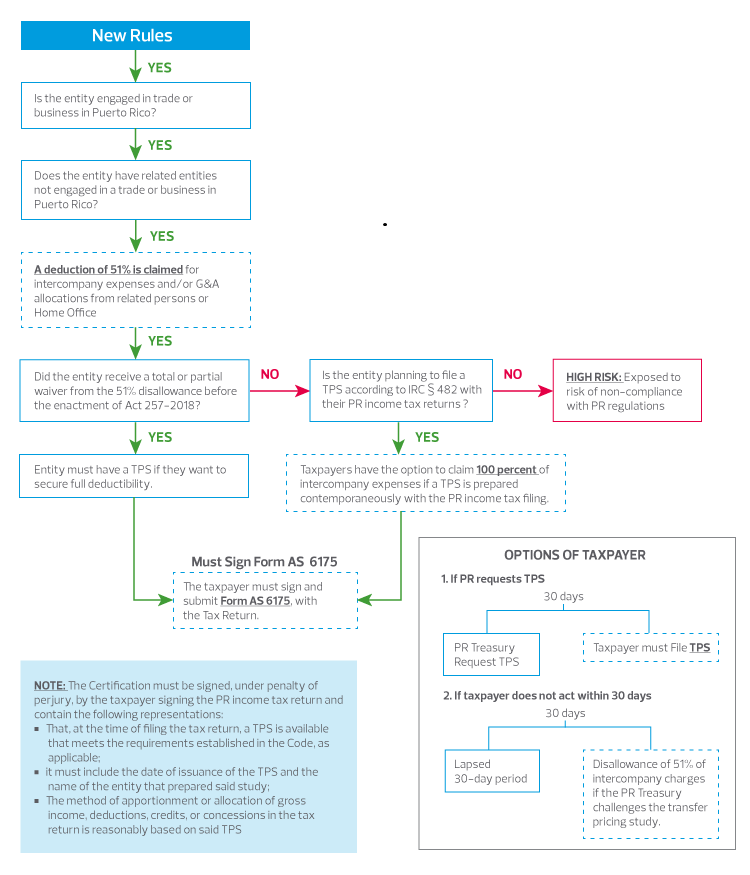
On May 11, 2021, the Puerto Rico Treasury Department (PR Treasury) issued Administrative Determination No. 21-05 (DA 21-05), establishing new rules that would require a transfer pricing study (TPS) to deduct cross-border expenses incurred with related entities not engaged in trade or business in Puerto Rico.
This article will discuss section 1033.17(a)(17) of the 2011 Puerto Rico Internal Revenue Code (the Code) and DA 21-05, which provides guidance for filing a TPS with the PR Treasury and clarifies new compliance requirements where there are transactions between affiliated entities in PR and the US. In addition, the article will briefly highlight Administrative Determination No. 21-08 (DA 21-08), which clarifies that the 30-day filing requirement applies to the TPS and not Form AS 6175 as required in DA 21-05.
Background
Puerto Rico has historically maintained a hands-off approach providing little to no guidance on transfer pricing. In recent years, new non-transfer pricing provisions have been introduced into the Puerto Rico tax rules, some of which affect intra-group transactions.
Act 257-2018 modified the 51% limitation allowing taxpayers to deduct 100% of expenses paid to related parties that operate within Puerto Rico and have related entities not engaged in a trade or business in Puerto Rico.
For tax years beginning after Dec. 31, 2018, the new rules allow such expenses to be fully deductible, provided the taxpayer:
- Signs and submits the approved Form AS 6175 Certification of Compliance (Certification) under penalty of perjury with the tax return.
- Prepares a TPS to confirm that the transaction(s) are arm's length based on sections 482, 6662, and associated regulations; and
- Completes the TPS contemporaneously with the tax return filing that reflects such transfer prices.
- Only reports submitted in accordance with US regulations will be accepted.
For the impact of changes to transfer pricing guidance under PR IRC, see below:
New disallowance limitation (section 1033.17(a)(17))
Transfer Pricing Study (TPS) under section 482
In preparing a contemporaneous transfer pricing study, a taxpayer must use the latest available information and data to establish its transfer pricing policy. The purpose of a taxpayer's TPS is to confirm that its transactions with related parties are priced consistently with the arm's length standard.
The following table presents a summary of TPS requirements under section 482:
| Scope | TPS requirements |
| Who must prepare? |
Taxpayers who meet either of the following conditions:
|
| What to prepare? |
Information as prescribed in section 482 (Transfer Pricing Documentation) Rules that covers:
|
| When to complete TPS documentation? | By the filing due date of the tax return: |
| What is the penalty for failing to file the TPS? | There are no explicit penalties for failing to comply with the local transfer pricing guidelines. However, in an audit contesting the TPS, the PR Treasury would disallow the 51% deduction of intercompany expenses. |
| Benefit of a TPS? | Taxpayers subject to the limitation explained above have the option to claim 100% of intercompany expenses if a TPS is prepared with the PR income tax filing. |
Takeaway
While taxpayers are not required to submit a TPS with the tax return, preparing a transfer study allows taxpayers to claim 100% of the deductions on intercompany expenses.
With the transfer pricing guidelines now firmly established, and an increased focus on audit activity, taxpayers should verify that their processes and documentation are up to date and compliant with these new requirements. PR Treasury has provided clear and extensive administrative guidance to inform taxpayers and assist them in complying with transfer pricing obligations. This guidance will continue to evolve as practical and technical issues arise in practice.