

$500M retailer uses Microsoft Dynamics 365 to boost unified commerce
Key takeaways



Overview
A middle-market apparel and footwear retailer with revenues of $500M brought in RSM to help with their journey to unified commerce. The retailer goes to market through 100 retail stores and an ecommerce site. RSM worked with the retailer to implement Microsoft Dynamics 365.
Challenges
The apparel and footwear retailer evolved over the years using multiple siloed systems. Although integrated, the applications did not work well together, which resulted in a poor customer experience.
The following pain points were identified:
- Significant transaction friction between channels (payment/tax system differences)
- Returns from online were not capable without customer service intervention
- Warehouses at capacity but still have subpar fill rates for online
- No customer data platform (anonymous customers)
- Large competitor investment in capabilities taking market share
Solution
Over several months of review and discussion, RSM’s team of experienced advisors worked with this retailer to establish a roadmap to unified commerce, focusing on the capabilities needed to address the retailer’s major pain points.
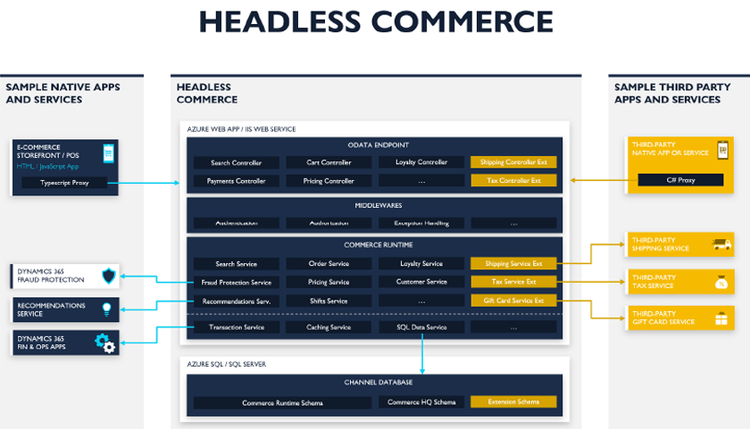
To achieve these capabilities, RSM worked with the retailer to implement Microsoft Dynamics 365 Commerce. Key elements of this solution included the following offerings:
- Order Management System (OMS)
- Store/Point of Sale (POS)
- Product Information Management (PIM)
- Inventory and Warehouse Management System (WMS) integrated to Salesforce Commerce Cloud for eCommerce
Unified commerce capabilities and results
After assessing the client’s pain points and business objectives, RSM’s team prioritized the following unified commerce capabilities:
- A customer data platform that collects customer information for segmentation and lifecycle management. This allowed the retailer to create better and more targeted offers—the next step in personalized marketing.
- Reduced friction from unified payments and taxes in POS, OMS and ecommerce, allowing for in-store returns of online sales. It also increased store traffic and upsells, and improved customer confidence in online purchases.
- An option to “buy online, ship from store” (via distributed order management), which significantly improved inventory efficiency. This ability also increased fill rates, reduced shipping times and lowered the amount of capital required for inventory.
- Access to inventory availability service. This improved online customers’ confidence to visit local stores. which in turn increased store traffic and customer satisfaction.
What happens next?
Every retailer is unique. Your company’s starting point with unified commerce may be different from the one described here. But even if your company isn’t ready to embark on a unified commerce journey yet, you can still start creating a plan. Connect with our team if you would like assistance with preparing a business case for your project.
Related insights
- /insights/technology/microsoft/composable-commerce-with-microsoft-dynamics-365-commerce
- /insights/technology/microsoft/headless-with-microsoft-d365-commerce
- /insights/technology/microsoft/a-1b-retailer-makes-the-move-to-unified-commerce