

Indirect tax services
Reducing complexity and improving compliance with skills, processes and technology
The digital economy has redefined how goods and services are exchanged, pushing businesses to adapt to increasingly complex value-added tax (VAT) and goods and services tax (GST) regimes. Frequent regulatory updates and real-time reporting mandates only heighten the pressure.
Internal tax teams are navigating limited resources, shifting rules and increasing stakes. The risk of errors or noncompliance is significant, potentially leading to penalties or reputational damage.
RSM helps organizations manage these challenges with practical experience, global reach and technology-enabled solutions tailored to their specific operations.
Common questions about indirect taxes
What are indirect taxes?
Indirect taxes are collected by an intermediary (such as a retailer) on behalf of the government. Unlike direct taxes, paid by individuals or companies, indirect taxes are typically embedded in the price of goods or services. Common examples include VAT, GST/HST and sales and use tax.
What is indirect tax compliance?
Indirect tax compliance involves accurately calculating, collecting, remitting and documenting indirect taxes in every jurisdiction where you operate. Effective compliance requires sound processes, technical knowledge and often automation to reduce risk and meet evolving mandates.
Value-added tax services (VAT)
Value-added tax (VAT) is the most common form of indirect tax worldwide and a growing compliance challenge for businesses operating across borders.
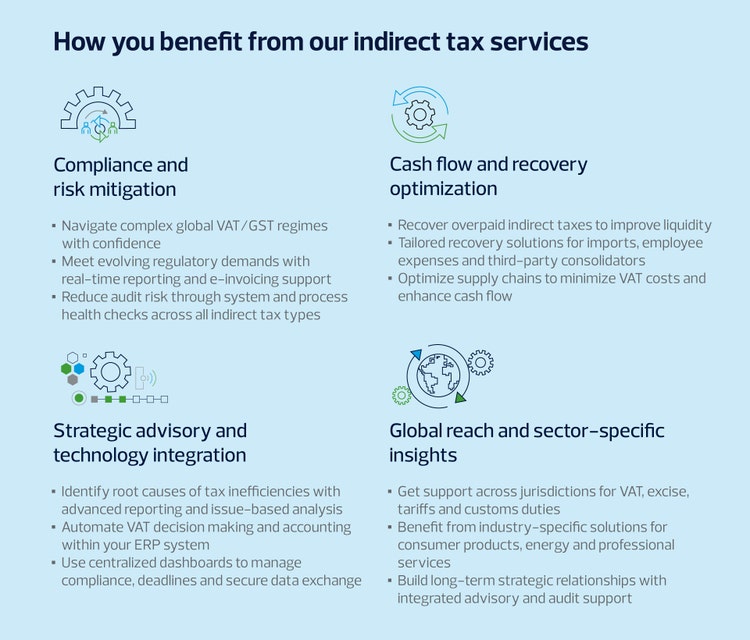
RSM’s U.S.-based global indirect tax team helps businesses navigate cross-border compliance with clarity and confidence. Whether you need to automate VAT workflows, optimize supply chains to reduce VAT costs, implement e-invoicing or establish governance processes for global operations, we provide integrated, technology-enabled solutions. With professionals in more than 120 countries, you gain global reach with local insight.
Meet growing global tax mandates with scalable, tech-driven value-added tax (VAT) automation. RSM assists you in integrating ERP systems, tax engines and e-invoicing tools to reduce manual effort and increase compliance. From automating VAT workflows to implementing country-specific e-invoicing solutions, we provide end-to-end support to modernize your indirect tax function and stay ahead of digital reporting rules.
Navigate value-added tax (VAT) obligations across jurisdictions with RSM’s tech-enabled compliance model. We streamline VAT compliance, reporting and digital filings using automation, data validation and tools like Tax Portal and Alteryx. From data cleanup to e-invoicing support, we help you reduce manual effort, improve accuracy and adapt to evolving global VAT rules.
Simplify multistate tax compliance with RSM’s sales and use tax automation. We assist in selecting, configuring and integrating the best software, defining internal processes and streamlining filing. By automating tax calculation and remittance, you reduce manual effort, improve accuracy and limit audit exposure—allowing you to focus on growing your core business.
Recent Insights from our VAT professionals
- /insights/services/business-tax/vida-reform-addresses-digital-trade-and-cross-border-compliance
- /insights/industries/consumer-goods/navigating-value-added-tax-implications-for-e-commerce-businesse
Related solutions
- /services/business-tax/indirect-tax/foreign-indirect-tax
- /services/business-tax/trade-advisory-services
- /services/business-tax/indirect-tax/domestic-indirect-tax
- /services/business-tax/sales-and-use-tax-automation
- /services/business-tax/international-tax/global-vat-compliance-and-reporting
- /services/business-tax/international-tax/vat-process-automation-and-e-invoicing