

What is an operating model and why does it matter?
Your operating model defines how your organization uses people, processes, technology and governance to execute your strategy. While your business model defines what value your company creates, an operating model determines how that value is delivered consistently and at scale.
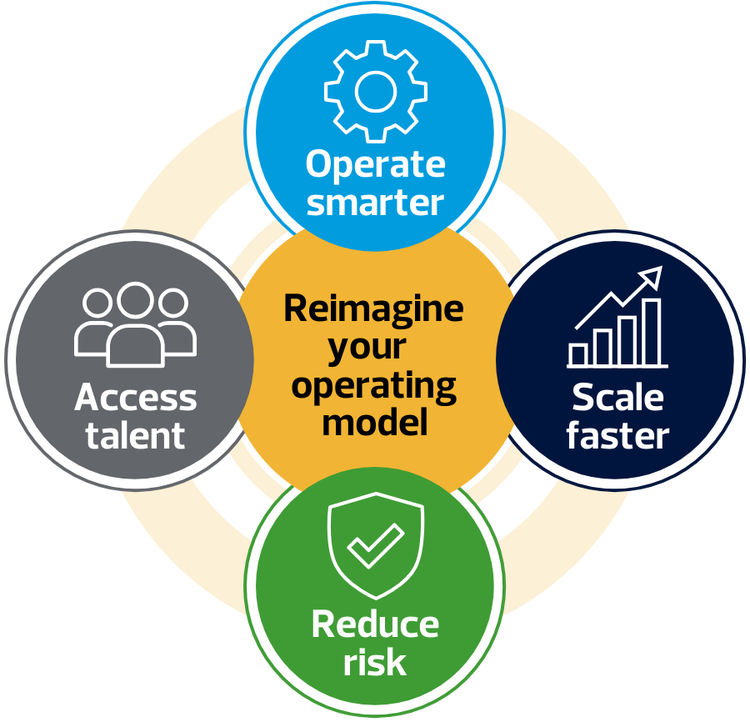
Key components of an operating model
- People: Organizational structure, leadership, culture and talent
- Process: Workflows, capabilities and decision making
- Technology: Systems, data and digital tools
- Governance: Oversight, accountability and controls
Why your operating model matters
- Aligns strategy and execution
- Improves operational efficiency
- Supports scalability
- Increases clarity and accountability
What is operating model transformation?
Operating model transformation is the process of redesigning how your people, processes, technology and governance work together to support business growth, improve operational efficiency and increase resilience.
What are the signs your operating model needs to change?
Organizations often revisit their operating models when growth creates operational strain, limits scalability or increases complexity.
Operating model transformation is often pursued when organizations:
- Outgrow existing processes that can no longer support growth
- Struggle to scale operations efficiently across teams and business functions
- Face ongoing talent shortages or difficulty accessing specialized expertise
- Manage increasingly complex technology environments and digital platforms
- Need more reliable data, reporting and decision-making insights
- Experience mounting security, compliance and governance requirements
- Seek greater operational efficiency while controlling costs
- Want to strengthen operational resilience and reduce key-person dependencies
Leading organizations are reimagining how critical functions operate by combining technology, specialized talent and managed services to improve performance, increase resilience, create capacity and support sustainable growth.
How can organizations reduce operational strain? 4 common approaches
Organizations typically utilize four approaches to address operating model challenges: process optimization, automation, specialized talent or managed services.
1. Redesign internal processes
Organizations may improve performance by simplifying workflows, clarifying responsibilities or updating governance structures.
Best for:
- Clearly identified inefficiencies
- Limited complexity growth
- Strong internal expertise
2. Increase automation
Technology investments can reduce repetitive work and improve consistency.
Best for:
- Highly repetitive processes
- Data-intensive workflows
- Standardized activities
3. Add specialized talent
Staff augmentation and contract resources can fill specific expertise gaps.
Best for:
- Project-based needs
- Temporary capacity shortages
- Specialized technical requirements
4. Adopt a managed operating model
Organizations can transfer defined responsibilities to experienced specialists while maintaining oversight and strategic control.
Best for:
- Persistent capacity challenges
- Ongoing operational needs
- Regulatory complexity
- Scalability requirements
- Access to specialized expertise
The right option depends on your organizational goals, operational maturity and the nature of the challenge being addressed.
Staff augmentation versus managed services: What's the difference?
To strengthen the operating model, many companies turn to staff augmentation and managed services strategies. Staff augmentation adds talent to an existing operating model while managed services provide ongoing support through a combination of people, processes, technology and governance.
| Staff augmentation | Managed services |
| Addition of specialized talent | Addition of talent, process and technology |
| Management by company | Management shared by company and provider |
| Short-term need | Ongoing operational need |
| Expanded capacity | Transformed delivery |
Both approaches can help address capacity challenges, but they solve different problems.
Staff augmentation adds specialized talent to your existing team. Your organization continues to manage the people, processes and outcomes.
Managed services provide ongoing support for a defined function through a combination of talent, processes, technology and governance, helping your organization improve scalability, consistency and operational resilience.
Generally speaking, staff augmentation helps when you need additional resources; managed services help when you need a more sustainable operating model.
Explore solutions by function
Is your reporting taking too much time and stifling strategic planning efforts?
Are your systems, infrastructure and applications becoming harder to manage?
Is your risk exposure increasing faster than your internal capabilities can keep up?
How are talent acquisition, retention and workforce support affecting your resources?
Are growing compliance demands and workforce expectations putting pressure on your payroll operations?
Do your decision makers have the trusted insights and scalable reporting they need?
Is growth creating greater operational complexity and increasing investor demands?
How difficult and resource-intensive is keeping pace with changing tax requirements?
How organizations are reimagining critical functions
Organizations rarely improve operational performance through a single initiative. Leading organizations combine process optimization, technology modernization, specialized talent and managed services to create more scalable operating models.
See how organizations have strengthened critical functions to address capacity challenges and improve performance:
- /insights/industries/life-sciences/from-science-to-scale-how-biopharma-geron-transformed-with-rsm
- /insights/services/managed-services/government-contractor-strengthens-compliance-and-cybersecurity-by-outsourcing
- /insights/services/managed-services/outsourcing-fuels-success-for-global-energy-business
- /insights/services/managed-services/investment-firm-gets-a-new-start-with-managed-services
- /insights/industries/health-care/transforming-financial-operations-for-an-expanding-surgery-practice
Why operating model transformation affects every business function
Finance, technology, security, HR and data teams do not operate independently. Challenges in one function often create inefficiencies across the organization. Effective operating model transformation improves coordination across people, processes, technology and data to support scalable growth.